

What is wild nature today? Here, this question is explored through a map which represents the infrastructure put in place to enable the Northern Bald Ibis to live as a wild animal again. It was created in collaboration with Vladan Joler and Gordan Savičić.
The Northern Bald Ibis (geronticus eremita) is a migratory bird with a historic habitat in Europe, the Middle East, and North Africa and a rich cultural history dating back to ancient Egypt. Its current global status on the ICUN’s Red List is “endangered”.
In Europe, the bird was breeding north of the Alps (in Switzerland, Southern Germany, and Austria) and spending winters in the south. It became extinct around 1621, due to over-hunting and adverse climate conditions (“little ice age”). In the 1950s, birds from a Moroccan colony were transferred to zoos and bird sanctuaries in Europe, held in captivity, and fed through the winter.
In 2013, after 11 years of pre-studies, a project led by Johannes Fritz (Waldrappteam ) began to rewild the Northern Bald Ibis in Europe. The majority of birds have been equipped with GPS trackers and are monitored in real-time. In the first 9 years, the number of rewilded birds rose from zero to almost two hundred. According to current models, at least 357 birds are necessary for the population to be self-sustainable. This number is projected to be reached by 2028, at which point the infrastructure mapped here is expected to be transformed significantly.
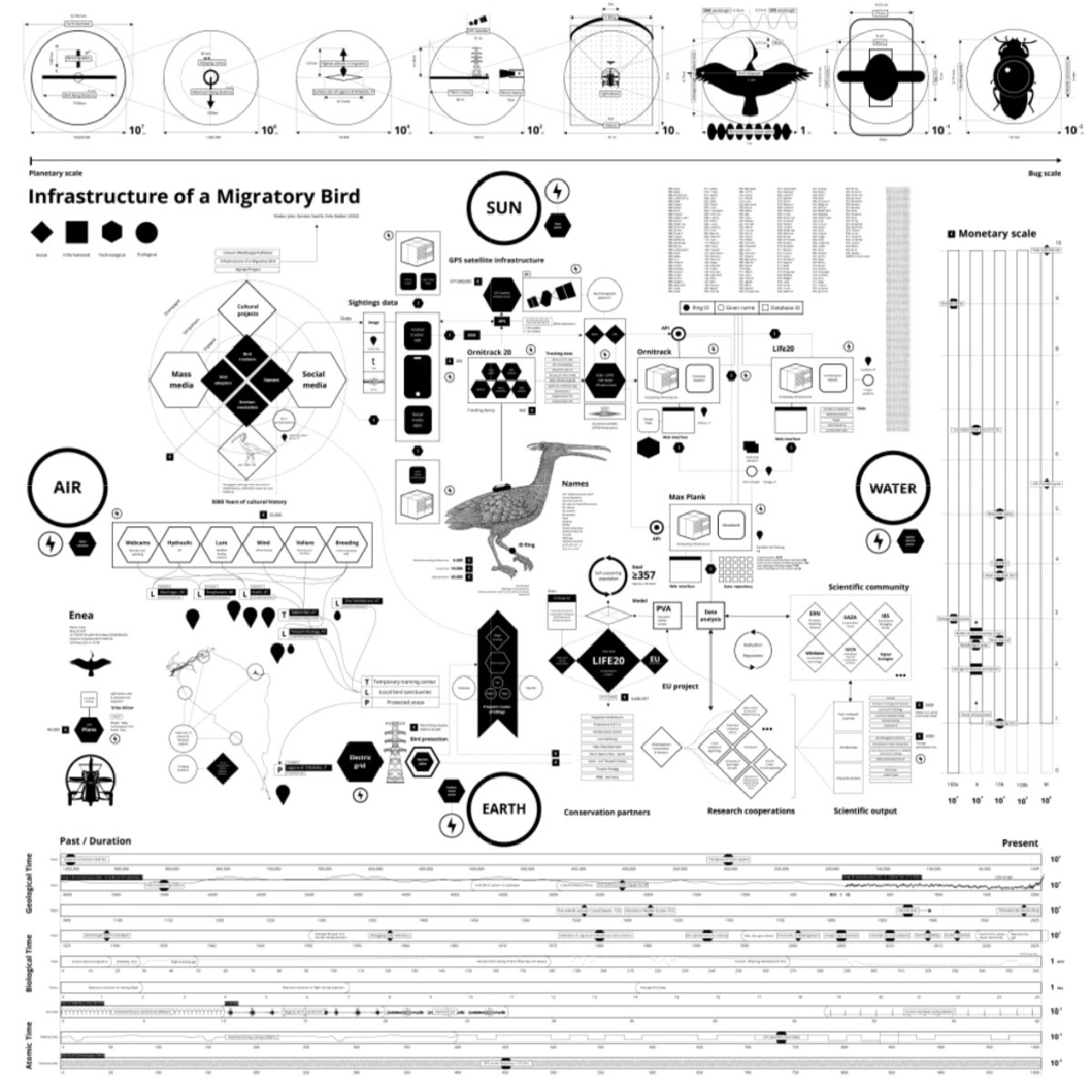
Structure of the Map
This diagram consists of a relational graph and three scales.
The graph shows relationships between social, technological, informational, and ecological elements which make up the anthropogenic ecosystem in which the bird is becoming wild again. It is divided into four quadrants. Top left are elements shaping the public’s understanding of and relationship to the bird. The top right comprises elements generating real-time data flows through which the birds are monitored and the rewilding project makes sense of itself. Bottom left are discontiguous locales connected and adapted to make room for the bird. Bottom right are institutional networks that make up the project, provide funding, and negotiate scientific value.
The scales show the spatial, monetary, and temporal dimensions of many of the elements that make up the relational graph. Thus, the scales provide another way of understanding these elements.
Interacting the Map
The map can be explored online at https://bird-map.net , with Audio Tours that offer different ways of reading this map.
Publications Based on this Research
Stalder, Felix, and Gordan Savičić. “From Environments to Infrastructures of Survival: The Case of the Northern Bald Ibis.” GeoHumanities, 2025. https://doi.org/10.1080/2373566X.2025.2574268 .
Using an interdisciplinary perspective, combining visual arts, media studies, and geography, we make visible how the notion of environments folds into the concept of infrastructure. Thus, the environment comes into view as something in need of continuing more-than-human maintenance and care, in order to serve as an infrastructure for survival.
Gordan Savičić, and Felix Stalder. “More-than-Human Care? The Biopolitics of Tracking Wild Animals.” Computational Culture, no. Special Issue: En/Countering Tracking. Resisting spatiotemporal media operations in computational culture, 2026.
Can tracking be understood as more-than-human care and constitutes a form of resistance to dominant practices of extractivism and reduction of nature to anthropocentric utility? We propose to differentiate between animal-centric and human-centric ends of tracking practices, based on their specific distribution of harms and benefits and the human-animal relations created thereby
Sollfrank, Cornelia, and Felix Stalder. Contemporaneity in Embodied Data Practices . The Contemporary Condition 20. Sternberg Press, 2025.
What parallels are there between a human pranayama practitioner and a migratory bird in heavily datafied environments? And what can they tell us about the need to reorient our thinking towards the planetary? A dialogical reflection on the entanglement of diverse temporalities in body-related, datafied, and experiential practices. Shifting through lived, historical, evolutionary, and technological rhythms, the authors unfold their respective more-than-human frames of reference, and arrive at specific forms of agency in the contemporary moment
Christensen, Michelle, Florian Conradi, Cornelia Sollfrank, and Felix Stalder, eds. Re/Embodied Data. Ambiguities of Knowing. Adocs, 2026.
We live in a moment of comprehensive datafication, as ever more aspects of our lives and the planet are measured, analyzed and shaped digitally. This opens new ways of knowing and doing, but all too often, it also leads to a systematic devaluation of forms of knowing that cannot be quantified and processed digitally. Rather than favoring one over the other, the relationship between quantifiable and experiential, abstracted and embodied knowledges must be explored. In this book, researchers in the arts and sciences address these differences through transdisciplinary collaboration and dialogue.
Savičić, Gordan, and Felix Stalder, Infrastructure of a Migratory Bird. Chaos Computer Congress 37C3. 2023. 41:33. https://media.ccc.de/v/37c3-12068-infrastructure_of_a_migratory_bird
We outline the heterogeneous elements that make up the infrastructure of the rewilding project and what kind of situations are being produced therein. The graph of “the infrastructure of a migratoy bird” shows relationships between social, technological, informational, and ecological elements which make up the anthropogenic ecosystem in which the bird is becoming wild again. The objective was to visualise and comprehend the intricate network of data, energy resources, and dependencies deeply enmeshed within the project’s framework.
Exhibitions of the Map as Large-Scale Print
2026
ArtScience Museum, Signapore, September 2026 to February 2027
Saigon, Athens, Greece, 5 March - 2 April
After the Algorithm, Zürich Switzerland, 20-29 March
2025
London Design Museum: More than Human Exhibition, 11 July - 5 October
Laboral. Digtal Machines Exhibition, 31 January — 27 September
2024
Swiss Design Award Nomination. Category Design Research, Basel
Vogelklang-Soundcamp #7, Stöcklewald, Furtwangen, Germany, 4 - 5 May
2023
Acquistion: City of Zurich, Art Collection
THE DIGITAL / GREEN / SOCIETY, Belgrade, Serbia, 14 - 16 May
Ars Electronica exhbition ‘Who owns the truth’ Linz, Austria, 06 - 09 September
2022
Gallery AIA, Zurich, Switzerland October 8, 2022 – January 31
Credits
This work was realized in the framework of the research project Latent Spaces: Performing Ambiguous Data , ZHdK.