

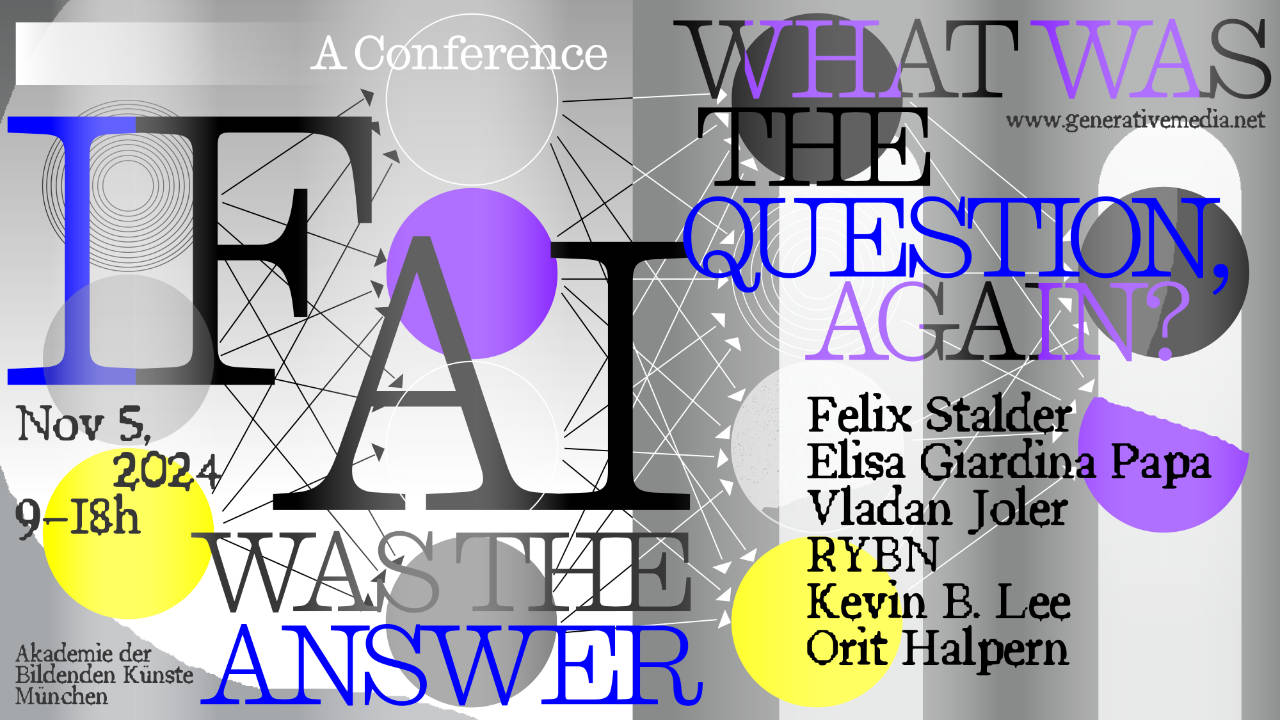
“If AI was the answer what was the question, again?”
Conference on Tue, Nov 5, 09–18
AdBK Munich, Akademiestraße 2, Main Building, Central Lecture Hall, free admission
With: Elisa Giardina Papa, Orit Halpern, Francis Hunger, Vladan Joler, Kevin B. Lee, RYBN, Felix Stalder, Hito Steyerl
The political economy of AI impacts on both its generative output as well as on art scenes and creative labor. Which strategies and tactics can artists employ in a sphere of corporate generative media to avoid redundancy and their own obsolescence? The conference tackles these questions through multiple perspectives: theft and extraction of data from users to train large generative AI models; the replacement of human labor; and the environmental impact of heavy computation.
Unreal Creations. Generative AI as premonition
It is often said that generative AI is conservative, even reactionary, that it can only recreate versions of the past, contained in its training data. That data, it is also regularly pointed out, contains mainly historical biases which generative AI reproduces and amplifies. Both of these claims are correct, and trigger calls to make AI more fair, accountable and transparent.
In my talk, however, I want to shift away from such questions of representation, and focus on the generative dimension. Generative AI produces “unreal data” — that is, presentations of things that do not exist, but might come into existence based on that data. They are premonitions of worlds to come. Thus, the question we need to ask is perhaps less whether the images (videos, texts, and sounds) are correct or fair, but whether the worlds they envision are desirable.